[NOTE: This post includes the text and PowerPoint slides for “Vectors of Reality, Part 3: The True, The Good, The Beautiful.” This is the third in a series of four talks on the mystical dimensions of life on Earth. At the end of this post, I have also embedded the full YouTube video of the talk itself. The text included here is not a transcript of the live talk as recorded on Zoom. Delivering the presentation, I read from this script, but also extemporize along the way. So there are some lines in the video that are not in the text version AND there are some lines in the text version that are not in the video. Also, there are numerous hyperlinks to authors and sources cited. I hope you enjoy exploring them. - Richard Power]
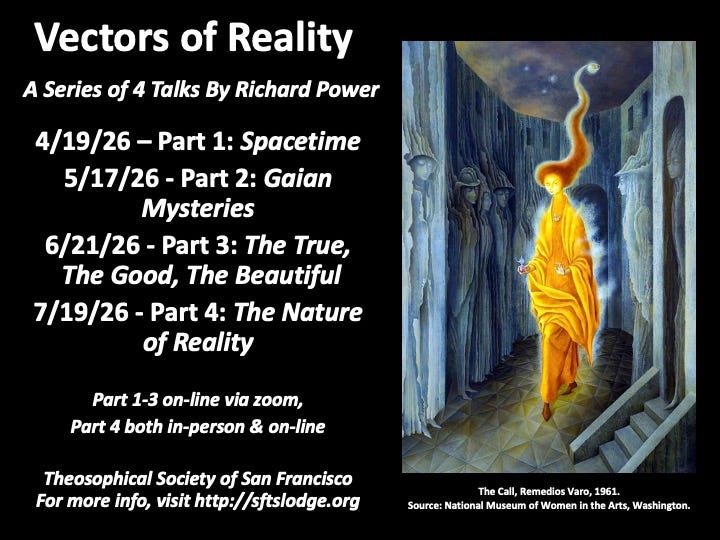
Welcome to “Vectors of Reality, Part 3: The True, The Good, The Beautiful.”
Third in a series of four talks on the mystical dimensions of life on earth.
Talks offered IN DEFENCE OF REALITY and as a CELEBRATION of the real Real.
In Part 1, I talked about Spacetime, where we stand, and holding space where we stand, and what space is in our personal lives – physically, psychologically, mystically, everything from Akasha to Individuation.
In Part 2, I talked about the Gaian Mysteries, “that in which we live and move and have our being” the Divine Feminine Intelligence that IS this Planet
In Part 3, I will talk about “the True, the Good, the Beautiful,” what our circumstances draws forth from us, what rises from within us to meet the challenges of human incarnation at this critical juncture in human herstory.
Just as the Gaian Mysteries flow from Spacetime, the True, the Good and the Beautiful flow from the Gaian Mysteries.
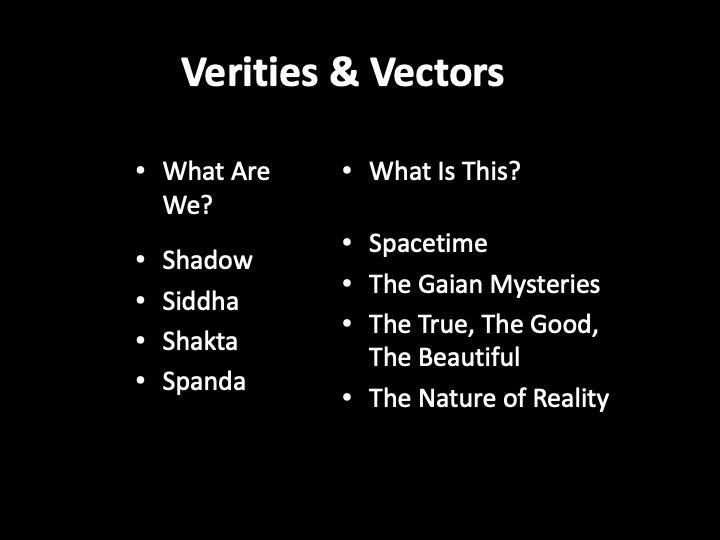
Vectors of Reality is the sequel to Verities of Being
Verities of Being addressed the question, “What Are We?”
Vectors of Reality addresses the question, “What Is This?”
In Verities of Being, Part 3: “Shakta” I spoke of the Deep Feminine, the Dark Goddess, the Dark Green Goddess, Her many names, East, West, North and South, including Fohat, her womanmanifestations, how She moves through everything and everyone, animating all life in this world …
In Vectors of Reality, Part 3, we are exploring …
What life and the world call forth from within us
What we resonate with in the world and in each other
That which exalts us
The True, The Good, The Beautiful
That which heals on a soul-level
That which nourishes us on a soul-level
The True, The Good, The Beautiful
These are the vital organs of Reality
The nectar of our humanity poured into the chalices of “I Am” and “We Are”
Our clarity of mind, our kindness, our sense of wonder, our sense of justice
The very taste of the exquisite
All of it
The nectar of our humanity
And yes, once again, we are broadcasting live from inside the singularity …
As articulated in Part 1 and Part 2, we are operating within the context of four prophecies, two of which have come to pass, and two more which we are working on, leaning into and holding space for. The two that have come to pass are the oldest of the four and the most recent of the four. In the 12th Century, the great Hildegard of Bingen prophesized the planetary eco-emergency we find ourselves struggling to mitigate today, and in 2010, I declared a Singularity was imminent, and by 2020, it had arrived, not the AI singularity, but a singularity in our own collective psyche, a singularity in the course of human evolution itself, and we are still in it ... The two prophecies we are working on, and leaning into, holding space for, are from the 1980s, and given to us by the legendary American sage Joe Miller, my Yoda, first he said we just had to make it through the next 100 years, because by then enough children would be borne just knowing, some critical mass number, some 100th Monkey type number, but maybe in the hundreds of millions, and their presence itself would finalize the great shift into the next iteration of civilization, a “New Age,” then a few years later he said that in this bright future the women would lead, it would be women who lead us into that New Age, and women who governed there
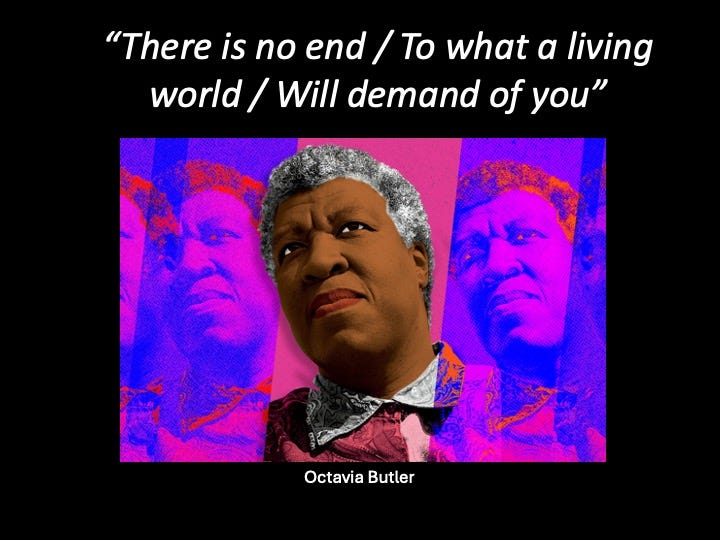
There is no end
To what a living world
Will demand of you
- Octavia Butler
Do you know Octavia Butler?
Octavia Butler, Hugo Award winner, Nebula Award winner, NAACP Image Award winner, author of the dystopian Sci-Fi masterpiece Parable of the Sower
Octavia Butler, “Mother of Afro-Futurism” (shoutout to the great Janelle Monae, deeply inspired by Butler’s work) …
In the January 2024 issue of The Atlantic, Tiya Miles wrote -
We need [Octavia Butler’s] conception of “histofuturism” now more than ever.
Somehow she knew this time would come. The smoke-choked air from fire gone wild, the cresting rivers and rising seas, the sweltering heat and receding lakes, the melting away of civil society and political stability, the light-year leaps in artificial intelligence—Octavia Butler foresaw them all.
Butler was not a climate scientist, a political pundit, or a Silicon Valley technologist. The author of imaginative and often disturbing speculative fiction such as Parable of the Sower (1993), she was a Black woman descended from enslaved people in Louisiana, raised by a strictly religious mother in Los Angeles, educated at community and regional colleges, and besieged by feelings of professional marginalization for most of her too-short life. Out of these challenging circumstances … and through the noise of late-20th-century America, Butler heard a clear signal: The future would not be like the present; it would, instead, be a techno-juiced doppelgänger of the past.
- Tiya Miles - How Octavia Butler Told the Future, The Atlantic, 1/12/24
Here is just a taste of Octavia Butler’s medicine –
“Create no images of God. Accept the images that God has provided. They are everywhere, in everything. God is Change— Seed to tree, tree to forest; Rain to river, river to sea; Grubs to bees, bees to swarm. From one, many; from many, one; Forever uniting, growing, dissolving— forever Changing. The universe is God’s self-portrait.” - Octavia E. Butler, Parable of the Sower
“That’s all anybody can do right now. Live. Hold out. Survive. I don’t know whether good times are coming back again. But I know that won’t matter if we don’t survive these times.”- Octavia E. Butler, Parable of the Sower
“In order to rise
From its own ashes
A phoenix
First
Must
Burn.”
- Octavia Butler, Parable of the Talents
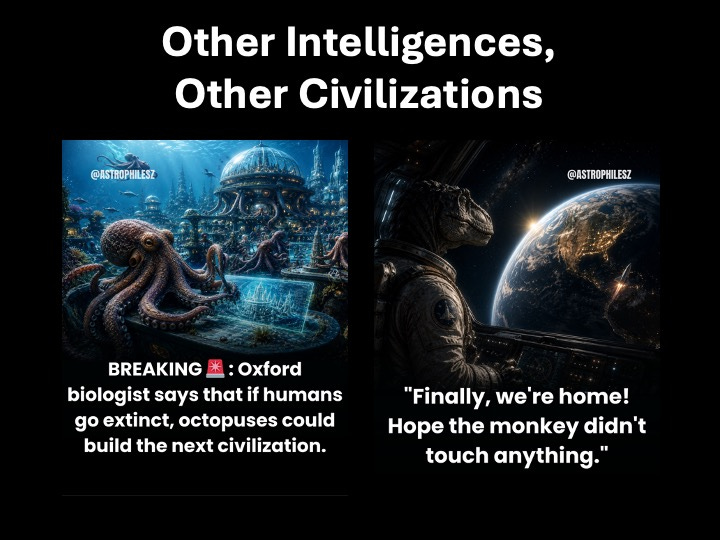
Of course … We might not make. We might not emerge from this Singularity.
It is only natural to wonder about the BEFORE and AFTER us here on Earth.
Professor Tim Coulson, a leading zoologist at the University of Oxford, argues that if humans were to go extinct, octopuses have the physical and mental attributes necessary to become the next civilisation builders. This is not a fringe opinion. It comes from his book on the universal history of evolution, and the reasoning behind it is worth taking seriously.
Octopuses already possess advanced cognitive functions including problem solving, tool use, object manipulation, and the ability to communicate with each other through rapid colour changes across their skin. Their dexterity, curiosity, and intelligence could, given evolutionary time, enable them to construct complex tools and build an underwater civilisation.
What makes octopuses genuinely extraordinary is their nervous system. Two thirds of their neurons are not in their brain but distributed throughout their eight arms, each of which can taste, touch, and act semi-independently. They are not one intelligence controlling eight limbs. They are closer to nine semi-independent processors operating in coordination. No other animal on Earth works quite like this.
Coulson acknowledges it may take hundreds of thousands or even millions of years for such evolution to occur … - @astrophilesz, 5/23/26Dinosaurs ruled this planet for roughly 165 million years. Humans have been around for about 300,000 … the Silurian Hypothesis, a real paper published by two actual scientists at NASA and the University of Edinburgh. It asks whether a technologically advanced civilisation could have existed on Earth before humans and left no detectable trace. Their conclusion was sobering. Given how completely geological processes recycle the crust over millions of years, we genuinely cannot rule it out. 165 million years is enough time for a civilisation to rise, peak, collapse, and be completely erased by geology. We would never know. - @astrophilesz, 5/23/26
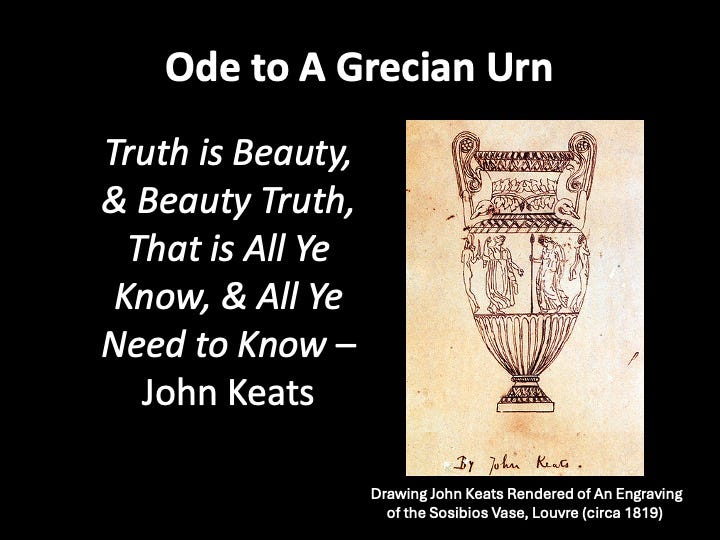
There was a cigar store on the corner of 207th and Broadway, it had a spinner rack of paperbacks, right at the front door, next to the newspapers and magazines, one of the tiers of that spinner rack held the “classics.” It was there I found Keats and Shelley, and Edgar Allen Poe. For less than a dollar each.
I was a pre-pubescent boy. And very much on my own.
But in that darkness of unknowing, Keats, Shelley and Poe led me to a glimpse of poetical knowing. “Truth is Beauty, & Beauty Truth,” Keats writes in Ode to A Grecian Urn, “That is All Ye Know, & All Ye Need to Know.”
Keats died of leukemia at the age of 25. He had written for maybe six years. He had sold maybe 200 books. He was living in Rome, at a villa on the Spanish Steps. It is now the Keats-Shelley Memorial Museum.
“His last request was to be placed under a tombstone bearing no name or date, only the words, ‘Here lies One whose Name was writ in Water. Severn and Brown erected the stone, which under a relief of a lyre with broken strings, includes the epitaph: This Grave / contains all that was Mortal, / of a / YOUNG ENGLISH POET, / Who, / on his Death Bed, / in the Bitterness of his Heart, / at the Malicious Power of his Enemies, / Desired / these Words to be engraven on his Tomb Stone / Here lies One / Whose Name was writ in Water …”- Wikipedia
These talks are in a way the culmination of a journey that began at that cigar store in “Little Dublin” (which is what my neighborhood was called by NYC politicians), that little cigar store with its spinner rack of its pocket-sized paperback “classics” and spy novels (oh yeah, that all too started there too).
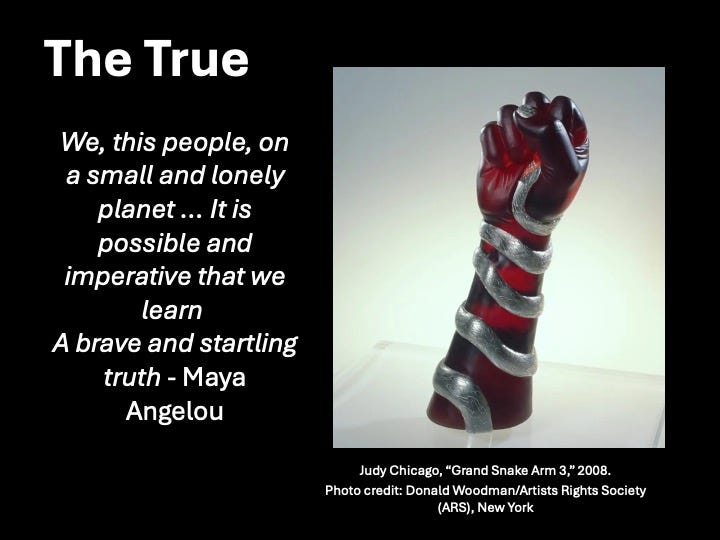
[NOTE; Judy Chicago, “Grand Snake Arm 3,” 2008.Photo credit: Donald Woodman/Artists Rights Society (ARS), New York. Courtesy of the artist and Jessica Silverman, San Francisco/© Judy Chicago / Donald Woodman / Artists Rights Society, New York]
It has somehow become impolite to talk about the truth on its own terms.
If you say something declarative about a truth.
Someone will reflexively say “Truth is relative.”
“You don’t believe in an ‘Absolute Truth’ do you?”
LOL. That’s a trap. Don’t allow the issue of Truth to be reduced to this false dichotomy of “relative truth” versus “absolute truth.”
Look outside. If it’s raining, it’s raining. Where you are, at that moment, it is raining. That’s reality. A truth is awareness, recognition, acknowledgment of a reality.
Yes, there are also the realms of belief and opinion, but truth and reality are independent of them.
What happens is that when someone (or some entity or some grouping), reaching for more power or greater profit, is confronted with “an inconvenient truth” they swiftly try to get that truth, that fact, relocated into the realms of belief and opinion. “Oh well, all truth is relative.” LOL
After a while, it’s bad for your career or your social status to simply state a fact, a truth, a reality, and so many start muttering about truth being “relative.”
Here are three insights concerning the nature of the Truth.
All from the 20th Century and from three VERY diverse sources
The first is from Hemingway.
When I turned from my teens to my twenties, I turned poetry to prose. BUT … In school, I had only gone as far as the 3rd Grade. I realized I didn’t know anything about how to write a sentence or construct a paragraph. And as much as I love Kerouac, commas and ellipses could only take me so far and that wasn’t far enough. So, I turned to Papa. To Hemingway.
Re-reading his greatest works taught me how to format sentences and craft paragraphs.
Hemingway also taught me one of the occult secrets of writing.
Sometimes when I was starting a new story and I could not get it going, I would sit in front of the fire and squeeze the peel of the little oranges into the edge of the flame and watch the sputter of blue that they made. I would stand and look out over the roofs of Paris and think, “Do not worry. You have always written before and you will write now. All you have to do is write one true sentence. Write the truest sentence that you know.” So finally I would write one true sentence, and then go on from there. It was easy then because there was always one true sentence that I knew or had seen or had heard someone say. If I started to write elaborately, or like someone introducing or presenting something, I found that I could cut that scrollwork or ornament out and throw it away and start with the first true simple declarative sentence I had written. – Ernest Hemingway, A Moveable Feast (1964)
Truth has an energy. Truth is an energy. A powerful energy. Limitless too.
The second insight is from a book I bought at Samuel Weiser’s some years earlier. Still in my teens. A hardcover copy of “Samadhi” by Mouni Sadhu. LOL.
The book didn’t resonate with me. Too mental. BUT throughout the narrative, the author kept quoting fragments from some obscure text the title of which did not register with me. Those fragments spoke to me. Directly.
So, I copied them out by hand, there were forty of them, I left Mouni Sadhu’s book behind, and just started studying them. Indeed, I kept that piece of paper, folded up, with me, in my satchel, for years …
Soon after I got to San Francisco, in 1978, and met the legendary American sage Joe Miller, he handed me a tiny pamphlet, I opened it up, and yes, it was those forty verses. Bhagavan Sri Ramana Maharshi had composed them. In 1928.
And the tiny pamphlet’s title? T-R-U-T-H R-E-V-E-A-L-E-D
Awareness is the nature of Reality.
Without awareness of Reality, can Reality exist? Because this awareness-reality, itself free from thought, exists as the source of all thoughts, it is called Heart. How to know it? To be as it is (thought-free) in the Heart, is to know it.
Awareness is All — the seer and seen, the real and apparent.
- Bhagavan Sri Ramana Maharshi, Ulladu Narpadu (Forty Verses of Reality)
The third insight is from a poem by the incomparable Maya Angelou. In June 1995, she was an honored speaker at the 50th anniversary of the United Nations.
And she offered the world “A Brave and Startling Truth” -
We, this people, on a small and lonely planet …
It is possible and imperative that we learn
A brave and startling truthAnd when we come to it …
When we come to it
Then we will confess that not the Pyramids
With their stones set in mysterious perfection
Nor the Gardens of Babylon
Hanging as eternal beauty
In our collective memory
Not the Grand Canyon
Kindled into delicious color
By Western sunsets
Nor the Danube, flowing its blue soul into Europe
Not the sacred peak of Mount Fuji
Stretching to the Rising Sun
Neither Father Amazon nor Mother Mississippi who, without favor,
Nurture all creatures in the depths and on the shores
These are not the only wonders of the world …
When we come to it
We, this people, on this wayward, floating body …
When we come to it
We must confess that we are the possible
We are the miraculous, the true wonder of this world
That is when, and only when
We come to it.- Maya Angelou reading her poem “A Brave and Startling Truth,” United Nations
Maya Angelou’s “Brave, Startling Truth” is particularly poignant within this context of this series of talks, because the Reality which is under attack, our shared reality, our common reality, is the one that took shape in the immediate aftermath of our victory in WWII, our victory over in the Nazis, the Fascists, the authoritarians ..
There is goodness in us. It is inborn. It is natural.
Cooperation, Community, Empathy, Compassion, Kindness … These don’t just exist in some percent of humans; Cooperation, Community, Empathy, Compassion, Kindness are evidenced in different ways throughout all of the natural world.
Goodness is pervasive.
Don’t get me wrong. To romanticize Nature as some kind of lovefest is as deluded as characterizing it as all and only “survival of the fittest.”
The real Real is so much more complicated than either of those fantasies.
BUT it is very true and very important to acknowledge that in Nature throughout Nature cooperation community empathy compassion kindness respect for diversity are all evident, at work, in the mix from the micro to the macro …
“Survival of the fittest” wasn’t even Darwin’s choice of words.
Herbert Spencer, an English philosopher from the 19th century, is best known for his adaptation of Charles Darwin’s theory of natural selection to human societies, which is termed Social Darwinism … He introduced the phrase “survival of the fittest” to describe this concept, positing that those who dominate in society do so due to their evolutionary advantages … Spencer’s work emphasized … a laissez-faire approach to economics … Spencer’s theories also had profound implications, particularly in the context of imperialism and militarism in the late 19th and early 20th centuries, where they were often misinterpreted to justify aggressive expansion and dominance of one nation over another …- Richard D. Fitzgerald, 2023 (EBSCO)
British biologist and anthropologist, Thomas Huxley (Aldous’ grandpa), came to be known as “Darwin’s Bulldog,” but as you see carrying Huxley was Herbert Spencer’s water in promoting “the survival of the fittest,” not Darwin’s.
Darwin’s conclusion would be more accurately described as “survival of the most adaptable” but even that, although not wrong, is too simplistic.
At the time, Huxley was challenged by the brilliant anarchist prince Peter Kropotkin.
In his Mutual Aid: A Factor of Evolution, Kropotkin wrote:
“The mutual-aid tendency in man has so remote an origin and is so deeply interwoven with all the past evolution of the human race, that is has been maintained by mankind up to the present time, notwithstanding all vicissitudes of history.”
“in the long run the practice of solidarity proves much more advantageous to the species than the development of individuals endowed with predatory inclinations”
“The species in which peace and mutual support are the rule, prosper, while the unsociable species decay.”
In his Anarchist Morality, Kropotkin wrote:
“The feeling of solidarity is the leading characteristic of all animals living in society. The eagle devours the sparrow, the wolf devours the marmot. But the eagles and the wolves respectively aid each other in hunting, the sparrow and the marmot unite among themselves against the beasts and birds of prey so effectually that only the very clumsy ones are caught. In all animal societies solidarity is a natural law of far greater importance than that struggle for existence, the virtue of which is sung by the ruling classes in every strain that may best serve to stultify us.”- Peter Kropotkin, Anarchist Morality
As I said, Cooperation, Community, Empathy, Compassion, Kindness are evidenced in different ways throughout all of the natural world.
A pod of dolphins saved a group of swimmers from a great white shark off the northern coast of New Zealand …. The incident happened when lifeguard Rob Howes took his 15-year-old daughter Niccy and two of her friends swimming … Mr Howes told the newspaper that the dolphins “started to herd us up, they pushed all four of us together by doing tight circles around us”. He explained that, when he had attempted to break away from the protective group, two of the bigger dolphins herded him back. He then saw what he described as a three-metre great white shark cruising toward them - but it appeared to be repelled by the ring of dolphins and swam away - Associated Press, “Dolphins save swimmers from shark attack,” Guardian, 11/23/04
A 12-year-old girl who was abducted and beaten by men trying to force her into a marriage was found being guarded by three lions who apparently had chased off her captors, a policeman said Tuesday. The girl, missing for a week, had been taken by seven men who wanted to force her to marry one of them … She was beaten repeatedly … She had been guarded by the lions for about half a day, he said. “They stood guard until we found her and then they just left her like a gift and went back into the forest” … Stuart Williams, a wildlife expert said the girl may have survived because she was crying from the trauma of her attack. – Associated Press, “Ethiopian girl reportedly guarded by lions,” NBC News, 6/21/05
19-year-old Kevin Hines decided to jump [from the Golden Gate Bridge] in September of 2006. Miraculously, he survived the 25-story plunge, but the impact of the water broke his back and shattered vertebrae, and the overwhelming pain rendered him unable to tread water. But before he started to sink, something brushed his legs. A sea lion was circling him, nudging him, and keeping him above water. Authorities were able to get to him and pull him out of the water, but he surely would have drown due to his injuries had he not been buoyed. - Anabel Conner, 15 Times Wild Animals Actually Saved Humans, Ranker, 10/4/21
Twelve-year-old Rheal Guindon of Ontario, Canada, was on a camping trip with his parents in when they decided to go out in the boat to go fishing. Rheal stayed on shore, but was horrified when he witnessed the boat tip over and his parents struggle in the water and drown. He walked toward the nearest town to get help, but when the sun set, he realized he would have to spend the night on the cold, damp ground. As he lay there crying, he felt a warm, furry body press up against him, which he thought was probably a dog. Delirious from his ordeal, he fell asleep. In the morning, he awoke to find three wild beavers huddled against him and across his body. They had saved him from freezing to death overnight when the temperatures dipped below zero. - Anabel Conner, 15 Times Wild Animals Actually Saved Humans, Ranker, 10/4/21
Goodness is pervasive.
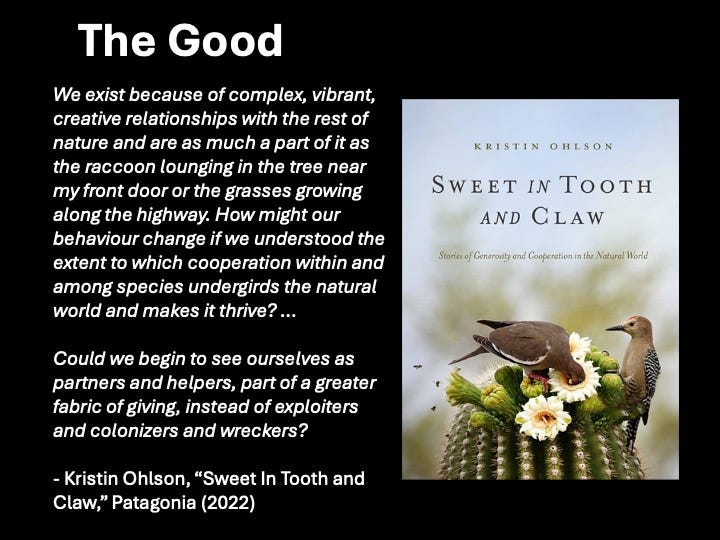
The debate between the Russian anarchist philosopher and Aldous Huxley’s grandfather took place two centuries ago. But Kristin Ohlson’s “Sweet In Tooth and Claw: Stories of Generosity and Cooperation in the Natural World” (2022) elucidates the ways in which our understanding has advanced and offers perspective on what we need to be working on at the civilizational level.
I heard Canadian forest ecologist Suzanne Simard speak at the 2015 Urban Soil conference in Los Angeles. For the last thirty years, she’s been uncovering the hidden cooperation among trees and other living things in the forest. In the process of writing The Soil Will Save Us, I was thrilled to learn about the life-giving partnership between plants and soil microorganisms. Really, it was the greatest of revelations to find out that plants don’t just suck nutrients from the soil and leave it as barren of goodness as a Twinkie but are engaged in a constant give-and-take with the billions of tiny organisms there. At the conference, Simard talked about this kind of fertile partnership spread out across the forest landscape, powered by a vast underground skein of fungi. I almost levitated from my seat with excitement …
Even many scientists don’t grasp how pervasive cooperative interactions are in nature. “Today’s ecologists grew up with the paradigm of organisms primarily competing with each other,” biologist Richard Karban told me. “A lot of ecologists are surprised by how much cooperation exists among plants and other organisms. They’re not looking for it in their research.” Consequently, we seem to have developed a zero-sum-game view of nature, suggesting that whatever we take—we humans, or those ravens, cypresses, invasive garlic mustard, or any living thing—comes at the expense of other living things and the overall shared environment. As we humans keep growing in number, this view suggests, it must regrettably follow that the rest of the world will suffer …
We exist because of complex, vibrant, creative relationships with the rest of nature and are as much a part of it as the raccoon lounging in the tree near my front door or the grasses growing along the highway. How might our behaviour change if we understood the extent to which cooperation within and among species undergirds the natural world and makes it thrive? … Could we begin to see ourselves as partners and helpers, part of a greater fabric of giving, instead of exploiters and colonizers and wreckers?
It seems to me that the best and highest use of science these days is to figure out how nature works—as many of the brilliant scientists I interviewed in this book are doing—and then to help humans change our behaviour so that we can roll back the damage we’ve already done and avoid further damage. So that we encourage and bolster the world’s hunger to thrive …
- Kristin Ohlson, “Sweet In Tooth and Claw: Stories of Generosity and Cooperation in the Natural World,” Patagonia (2022)
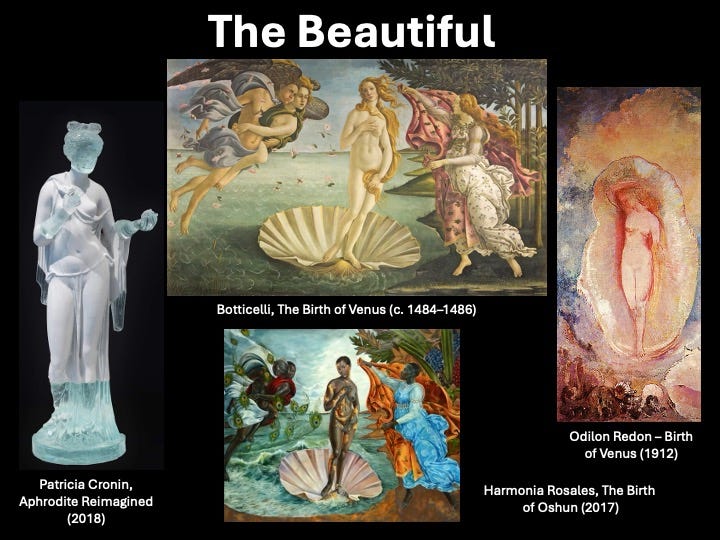
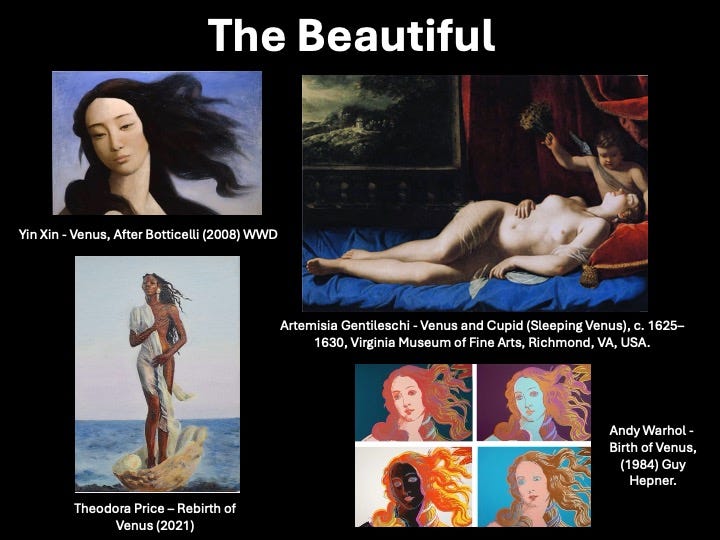
A large print of Botticelli’s “Birth of Venus” hung over my mattress in my flat on Prince Street, in lower Manhattan, in my early twenties, and then California with me, and moved with me from flat to flat, throughout my late twenties and all through my thirties … I had never explained it to myself, I just felt it, it nourished me, it protected, I didn’t think about how or why, I just felt it … Looking back on it now, so much meaning reveals itself, consider the painting against the historical backdrop, the HERSTORICAL backdrop more accurately, 16th century, it is a pagan painting, it is Goddess worship, this is Venus after all the Goddess of Beauty, Love Goddess, flowing red hair, emerging from the sea, just as, in the beginning, Life itself emerged from the sea, “Birth of Venus” and “Primavera” stood in defiance of the Pathology that acted out with such cruelty and terror in the Inquisition, and that was tightening its grip at the time, Botticelli himself felt Savonarola’s chill breath on his neck and after “Birth of Venus” and “Primavera” his painting took on a very different, still exquisite, but much safer persona …
I have curated eight artistic renderings of Venus Aphrodite for you, four on each of these two slides, four by women, four by men, five of them flow from the central image, Botticelli’s “Birth of Venus,” these eight images sing of the Deep Feminine, the Divine Intelligence itself, in contradistinction to the false gods proffered up by patriarchy and oligarchy fueled as they have been by ignorance and pathology
One afternoon at the Monterrey Aquarium. Sometime in the late 1980s or early 1990s.
As I roamed the halls, my eyes exploring the tanks through the floor-to-ceiling glass windows, taking in the wonderousness of it all, the deep green of the slowly undulating kelp forest, the rainbow swarms of diverse fish species, the sharp-edged hardness of the multi-hued coral reef and then I saw something I can see clearly and feel as directly as I did in the moment, it was some sea creature, a sea of so dazzling, so scintillant, so blazing, I can’t even identify what it was – I don’t think it was a moon jelly, although they are exquisite, I don’t think it was a white coral, it might have been white plumed sea anemone, but I can’t be sure, I have searched but haven’t found a photo depicting the creature that I saw, or at least as it was revealed to me in that moment, the whiteness, the pure, utter whiteness, a supernatural whiteness, as I said, scintillant, dazzling … In that moment, I said to myself, in the silence of my own psyche, “this is proof-positive, irrefutable evidence, that there is indeed a divine intelligence behind all of creation, nothing less,” it’s none as if I had harbored any doubt ever, I hadn’t, but still, there it was.
Truth is a mountain. Massive, still, SILENT, unbreakable.
Goodness is a great river running through it all. Like the Amazon, the fastest. Like the Nile, the longest. Constant. Always flowing. Always in one direction.
But Beauty is of a different order; She is Herself a different dimension than that to which Truth and Goodness belong.
Beauty is mysterious. Truth is not. Truth wants you to know. Everything. Beauty is ineffable. Goodness is not. Goodness is reliable, uncomplicated, your best friend.
In that landscape of the human psyche, with its Truth-Mountain and its flowing River-of-the-Good, Beauty is more like an etheric nerve system, it occupies the same space as Truth and Goodness but is itself a whole other dimension all its own, it runs through everything everywhere (I don’t say everyone, because, well, ignorance and pathologies). This etheric nervous system that is beauty residues silently in everything everywhere, but now and then, here and there, like a chameleon shifting from one gorgeous color to another in a matter of seconds, this etheric system shifts modes and a portal opens, and we gasp and weep and tremble, uttering “Oh, look, this is so beautiful.”
The portal is like an etheric temple that coalesces seemingly out of the air itself, the portal temple beauty shimmers in and out of sight, sometimes immersed in the primordial darkness, which is after all Her own flesh, an etheric temple which shimmers in and out of consciousness, sometimes submerged in dreamtime, or is that her very nest, she is always dancing, always moving, on her own terms, following her own cryptic agenda …
Consider how four great beings I have randomly selected for you struggle to describe or define her –
The beauty of the world, which is so soon to perish, has two edges, one of laughter, one of anguish, cutting the heart asunder. - Virginia Woolf
The pursuit of truth and beauty is a sphere of activity in which we are permitted to remain children all our lives. - Albert Einstein
Beauty is unbearable, drives us to despair, offering us for a minute the glimpse of an eternity that we should like to stretch out over the whole of time. - Albert Camus
Whenever I experience something beautiful, I am with Soul. That moment of inward breath, that pause and awareness of “how beautiful this is” is a prayer of appreciation, a moment of gratitude in which I behold beauty and am one with it. - Jean Shinoda Bolen
LOL. Can you see what She does to us?
I opened this series of talks by declaring that Reality itself is under attack
This is not to imply that this is something that has never happened before.
Indeed, for millennia (that’s plural), pathology and ignorance have struggled against Reality, seeking to blunt the arc of human evolution.
But there are moments, periods of time, eras, in which the battle could literally be won or lost, with finality, and this is such a moment, arguably the final battle.
This 21st Century, the first of the 3rd Millennium, offers both the direst of threats and the brightest of opportunities. Looking back over the dangerous millennia we have already survived, there is medicine to be gathered, potent medicine, mind-expanding, heart-expanding, soul-reiviving medicine, this potent medicine is our heritage, it delivers both inspiration and a warning
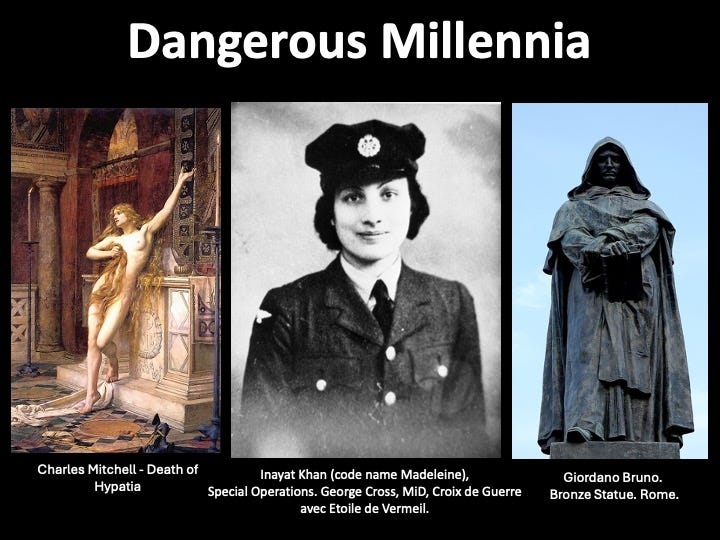
Hypatia (c. 370-415 AD).
Neoplatonist. Mathematician. Astronomer. Greek woman. In Egypt.
Taught at the School of Alexandria. Wrote books.
Influenced many of the great minds of her time. Shared Plotinus with them.
Opened their eyes to the Greek Mysteries and to the Goddesses.
Most other scholars had converted to Christianity to avoid persecution. She refused.
John of Nikiû depicted her as a pagan woman with “Satanic wiles” who “beguiled the people” and turn them against the church “through her enchantments.”
She was dragged from her chariot by a “Christian” mob.
Stripped naked. Flayed alive. Her corpse burnt. In a church. At the age of 45.
Hypatia has a table setting at Judy Chicago’s The Dinner Party.
Embroidered on the back of the runner are four crying female faces from youth to old age that represent Hypatia in the Coptic style, suggesting that she stood for women of all ages. The image’s blurred appearance, and the depiction of four limbs being pulled in different directions represents the brutality of Hypatia’s death and the conflict created by her religious beliefs. Chicago uses a blood-red color in this panel, along with a rainbow of tones, which suggests the dichotomy of violence and beauty in Hypatia’s life. A rendering of Hypatia’s face, based on an actual Coptic weaving of a goddess, peers through the capital “H” in her illuminated letter. Her mouth is covered in a band, which represents her silencing as well as the “deliberate muting of other powerful women. - Judy Chicago, Hypatia Place Setting, The Dinner Party, Brooklyn Museum
A century or so after Botticelli painted his “Birth of Venus,” steeped as it was, and is, in the Deep Feminine, Giordano Bruno (1548-1600), Dominican friar, philosopher, mathematician, astronomer, was burned at the stake for articulating a philosophical world-view just as steeped in the Deep Feminine.
“Divinity reveals herself in all things. Everything has Divinity latent within itself. For she enfolds and imparts herself even unto the smallest beings, and from the smallest beings, according to their capacity. Without her presence nothing would have being, because she is the essence of the existence of the first unto the last being.”
“Animals and plants are living effects of Nature; this Nature … is none other than God in things … Whence all of God is in all things … Think thus, of the sun in the crocus, in the narcissus, in the heliotrope, in the rooster, in the lion… . To the extent that one communicates with Nature, so one ascends to Divinity through Nature.”
“Those wise men knew God to be in things, and Divinity to be latent in Nature, working and glowing differently in different subjects and succeeding through diverse physical forms, in certain arrangements, in making them participants in her, I say, in her being, in her life and intellect.”
– Giordano Bruno, “The Expulsion of the Triumphant Beast” (1584)
Noor Inayat Khan. Daughter of the great Sufi teacher Hazrat Inayat Khan. Raised in her father’s Fazal Manzil (trans. “House of Blessings”) on the outskirts of Paris.
She studied child psychology at the Sorbonne.
She wrote children’s stories for Le Figaro.
In 1940, when the Nazis invaded France, the Khan family escaped to Britain.
Noor joined the Women’s Auxiliary Air Force and became a wireless operator. But in 1943, she was recruited by Churchill’s Special Operations Executive (SOE). And the work of the SOE? Conducting espionage, sabotage. Aiding resistance movements.
Noor Inayat Khan became a covert operative. Churchill’s orders were unambiguous: “Set Europe ablaze.” Noor was sent into occupied territory as a radio operator to aid the French Resistance. Betrayed by an informant. Captured. Sent to Dachau. Tortured. Executed at the age of 30. Recognized as a Saint in Sufi circles.
She was a natural for espionage work being fluent in French and familiar with Paris. One of her SOE instructors called her “very feminine” and “interested in personalities, capable of strong attachments, kind-hearted, emotional and imaginative.” The instructor said: “The motive for her accepting the present task is, apparently, idealism. She . . . was longing to do something more active in the prosecution of the war, something that would make more call on her capabilities and, perhaps, demand more sacrifice” … She told her captors nothing and her last word was said to be “Liberté”. Khan was posthumously awarded the Croix de Guerre with Gold Star and the George Cross.
- Mark Bridge, Brave spy Noor Inayat Khan is first woman of Indian heritage to win plaque honour, Times, 8/28/2
See also “Enemy of the Reich: The Noor Inayat Khan Story” (PBS, 2014) AND Shrabani Basu’s Spy Princess: The Life of Noor Inayat Khan
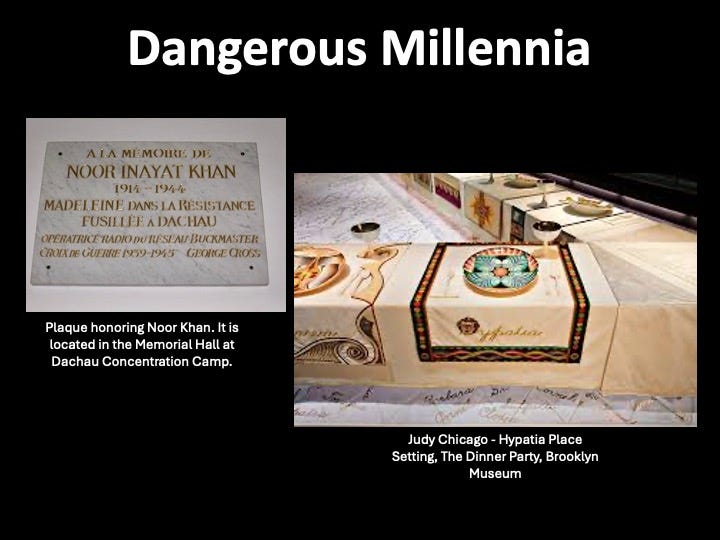
Hypatia was stripped naked and killed by “Christians” who were not true Christians. Giordano Bruno was burned at the stake for articulating a philosophy grounded in the Primordial Goddess and a Cosmos composed of infinite worlds. Three centuries later, Noor Inayat Khan tortured and executed at Dachau for fighting Evil Incarnate.
Hypatia was killed in 415 AD.
Giordano Bruno was killed in 1600.
Noor Inayat Khan was killed in 1944.
Dangerous millennia. Plural. Not millennium. Singular. Millennia. Plural.
Throughout human history, thousands of years, ignorance and pathology have been struggling against Reality, against the True, against the Good, against the Beautiful.
But this period we found ourselves, this is extra, this is unique, I call it the Singularity, we may or may not survive in any recognizable form. This is extra. This is unique. The planetary climate emergency. 8 billion humans. Too many. Consuming Earth’s resources 73% faster than our planet’s ecosystems can regenerate them. Add in the mind-debilitating impacts of social media and AI. This is extra. This is unique in human history.
We are either going to shift into a new civilization, as I said in Part 2, a green, woke, feminist civilization, or we will find ourselves to be our own an extinction-level event.
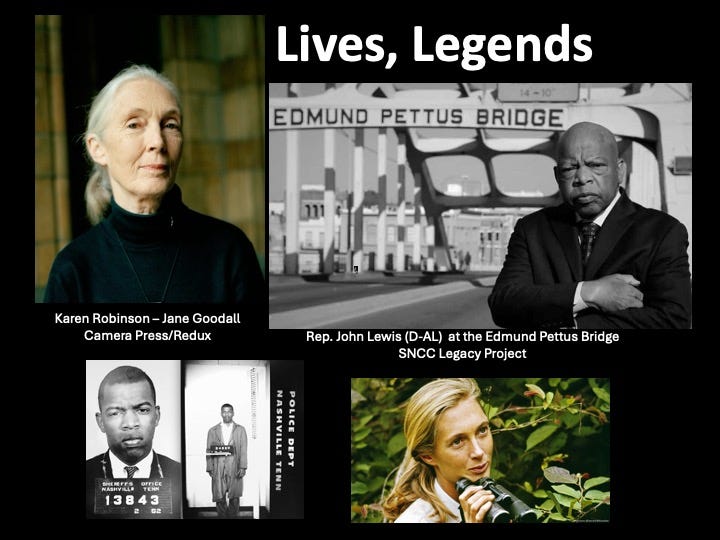
So yes, some, Bruno and Noor Inayat Khan are called to become legend through the powerful example of their martyrdom, but others are called to become legend by living long profoundly impactful lives.
For example, Jane Goodall and John Lewis.
Both had long lives of meaningful work for our species and our world.
Both died recently. Lewis in 2020 at the age of 80, Goodall in 2025 at the age of 91.
LONG LIVES OF LEGEND!
Jane Goodall. Primatologist. Anthropologist. UN Messenger of Peace.
Throughout her life and remarkable career, Jane inspired generations of scientists, brought hope to countless people from all walks of life, and urged us all to remember that “every single one of us makes a difference every day – it is up to us as to the kind of difference we make”. - Jane Goodall Institute, Remembering Jane
“We can’t leave people in abject poverty, so we need to raise the standard of living for 80% of the world’s people, while bringing it down considerably for the 20% who are destroying our natural resources. - Jane Goodall, 2002 World Summit on Sustainable Development
“I do believe there is a window of time when we can at least slow down climate change and loss of biodiversity. But only if we get together and take action now. And without hope we will fall into apathy and do nothing. Then we are doomed.” – Dr.Goodall’s 2025 Earth Day Message.
John Lewis was arrested 45 times, 40 times in the 1960s, as a leader of the non-violent civil rights movement in the southern United States, and 5 times as a member of the House of Representatives, including twice protesting apartheid in South Africa, and once protesting genocide in Darfur. He was beaten numerous times. By angry mobs. In 1961. During the Freedom Rides.” In 1965. On “Bloody Sunday.”
“If courage had a name, it would be his … For John Lewis, voting was sacramental. And he shed his blood for us to exercise this most fundamental of human rights. Forevermore, generations, starting with this one, will honor him by casting their ballots. A secular communion meant to strengthen our democracy. His roar as the conscience of the Congress will echo down through history. Few who ever lived have done more to inspire change.” - Henry Louis Gates, Jr. Remembers John Lewis, PBS, 7/22/20
“Freedom is not a state; it is an act. It is not some enchanted garden perched high on a distant plateau where we can finally sit down and rest. Freedom is the continuous action we all must take, and each generation must do its part to create an even more fair, more just society.” - John Lewis, Across That Bridge: A Vision for Change and the Future of America
“You are a light. You are the light. Never let anyone — any person or any force — dampen, dim or diminish your light … Release the need to hate, to harbor division, and the enticement of revenge. Release all bitterness. Hold only love, only peace in your heart, knowing that the battle of good to overcome evil is already won.” - John Lewis, Across That Bridge: A Vision for Change and the Future of America
LONG LIVES OF LEGEND!
Who replaces them? How could anyone pick up the slack left behind by their departure?
Such beings are like old growth forests.
You can plant trees; you can raise up a new forest.
But you can’t fast track an old growth forest.
You cannot synthesize the richness of that medicine.
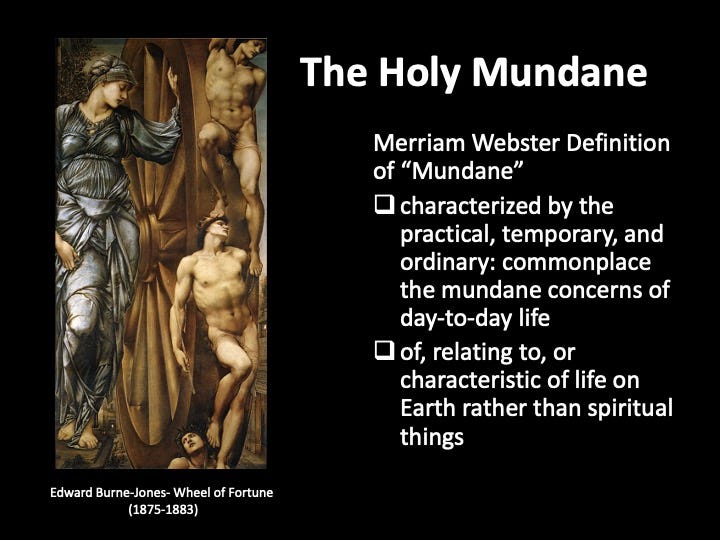
So far we have honored three great beings who were martyred in defense of the True, the Good and the Beautiful, and two great beings who lived long lives of legend, but what about all of us, what about those who have not been woven into the official, public narrative of our species, who have not obtained fame or even recognition.
What is our role in all of this, this defense of Reality, the celebration of the real Real?
Wholly Mundane – Holy Mundane
Oxford Languages -
mundane
adjective
/mʌnˈdeɪn/
/mʌnˈdeɪn/
(often disapproving)
not interesting or exciting
1. a mundane task/job
2. I lead a pretty mundane existence.
3. On a more mundane level, can we talk about the timetable for next week?
Sometime in the 1980s, I took a walk with Abdul Aziz Said, an esteemed Syrian-American Professor of International Relations at American University, diplomat, peacemaker, advisor to governments, AND a true for real Sufi. He was visiting Northern California. And he had spent an afternoon with his friend Joe Miller, who in turn arranged for me to take that walk. Having an in-depth conversation with someone like Abdul Aziz Said is like open heart surgery, and brain surgery, at once, but with etheric scalpels, etheric forceps, etheric retractors, making etheric incisions and etheric sutures, with a joyful peace as anesthetic. LOL. There is much I could say about that conversation, but here and now I’m only going to share this one profound moment. This was around the time I had asked Joe about the hell was going on in human evolution and whether there was any hope for us. So, I asked Abdul Aziz about it all too. And his answer has stayed alive all these years.
He said none of us really know how much of a difference we make.
He said we do not understand how much worse it would be without us, wherever we are, whatever we are doing, whoever we choose to be. He said we have no idea how bad it could be or would without us, without our beings, without us simply holding space, without the hope that we carry inside of us, without our goodness, our truth, our vision of beauty.
It could all be so much worse. It would all be so much worse without you.
Seriously. Just by being alive and holding up the True, the Good, the Beautiful, in your own way, in your own voice, in your own thoughts and feelings, in your own quietude, even in your own confusion or despair, you are contributing - in mysterious ways you cannot comprehend - to the redemption of our species and the rescue of our world.
Simply by being yourself, by naming the True, by serving the Good, by hallowing the Beautiful, by creating, by offering, by simply abiding, bearing witness, taking action in whatever ways come to you naturally.
Abdul Aziz Said died in January 2021at the age of 90. Another long life of legend!
There’s an old story about Octavia Butler that I often return to: A young man once asked the visionary science fiction novelist the answer to ending all the suffering in the world. “There isn’t one,” Butler replied. “So we’re doomed?” he asked, confused. “No,” said Butler. Then she delivered the words that would remake my understanding of the future: “There’s no single answer that will solve all of our future problems. There’s no magic bullet. Instead, there are thousands of answers—at least. You can be one of them if you choose to be.” – Mary Retta, Welcome to Janelle Monáe’s Dreamworld, Wired, 4/26/22
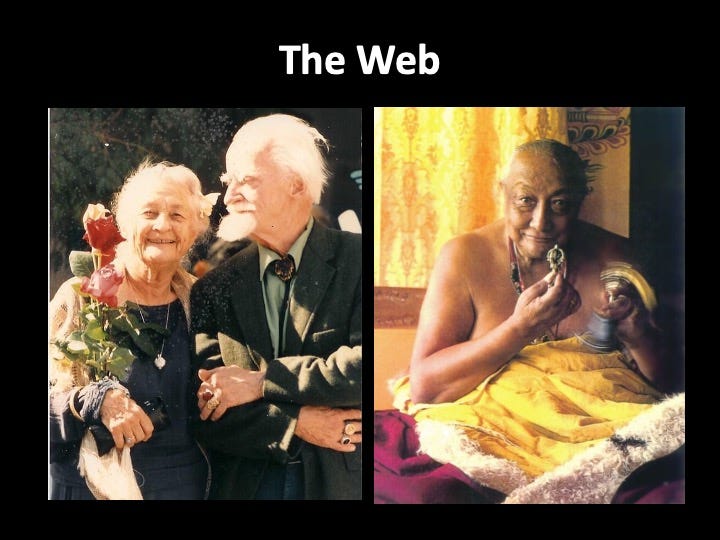
“Failure to recognize the void nature of mind is the very source of samsara. This void nature, with its inherent compassion, is recognized when the mind, free of the influence of thoughts, awakens to the simple awareness of the present.”- Dilgo Khyentse Rinpoche, The Heart Treasure of the Enlightened Ones
Death of Dilgo Khyentse Rinpoche (Excerpted from “I, the Dragon”
One night, the phone rang just as I was giving Joe his goodnight hug. The ring felt urgent and heavily loaded. It was our beloved friend and fellow Lodge member, A.J. Dickinson, an ex-pat living in Kyoto. A.J. had traveled and studied closely with the highest of the Tibetan teachers, Dilgo Khyentse Rinpoche. A.J. was an accomplished healer, and had done a lot of bodywork on Dilgo Khyentse Rinpoche and some of the other great ones. That night, he was calling to tell us that Dilgo Khyentse had just passed on from this life, over in the Himalayas. Dilgo Khyentse had been the senior lama of the Nyingmapa tradition, he was the builder of Shechen Monastery in Nepal, the guru of the Bhutanese royal family, the Dalai Lama’s Dzogchen instructor and his powerful teachings have been preserved in several exquisite books. It was a significant moment. I glanced at Joe, Joe glanced at Guin, Guin glanced at me, I glanced back at Joe. No one said anything. Dilgo Khyentse was profoundly important to all of us, the three of us in that room, and the magnificent friend at the other end of the phone call. We were and are all intricately bound together. It was the beginning of the end and the end of the beginning. Dilgo Khyentse’s death was like a signal. Both Joe and Guin would be dead in a year or so. The true government of the world was undergoing a changing of the guard.
Photographs of Dilgo Khyentse always stirred me, I kept one with me at all times. I had been fortunate to attend an empowerment he gave during his visit to California, years before. And for over a decade, I had made an in-depth study of his teachings. His power was great. I had felt the intensity of his insight into the nature of reality, on a constant basis; I had felt the blessedness of his presence on this plane. It was a palpable substance within the invisible world. But like a burning stick of exquisite incense it had reached its end. And that night, I felt him leave. A gaping hole in the interior structure of the world closed up behind him. And I felt the luminous web of life immediately begin to repair that tear in its membrane. Such a hole in the luminous web of life is repaired with the mystical tissue of those expanding hearts that are somehow bound up with the departed being and its karmas.
September 1991: Dilgo Khyentse Rinpoche passes on Sept. 28, 1991.
August 1992: Joe Miller passes
Novermber 1992: Guin Miller passes
November 1992: Dilgo Khyentse Rinpoche cremation
Although Joe didn’t talk about this much, he did on rare occasions, mention “the 36”:
“Who knows how many if any - there may be some seated in this room-who are among the Thirty-Six? It is stated that the world couldn’t run without the Thirty-Six. This is from the Jewish teachings. It is said that those thirty-six do not know what it is that they are here for, but that they are acting as channels to let it flow through them – what should be here to keep the world in balance. So who knows. There are similar things in the Sufi tradition. They are called certain names, they are not usually known. There are always so many in incarnation to keep the balance so that the Force will still be flowing through to humanity. Despite what they’re doing at this intimate level, the Ultimate is pressing through. You might say, how could somebody be such a one and not know it? Well, he could be deaf or dumb. He could be a dummy or a cripple or a politician. No, no, I doubt that....So you talk about a thousand in one chance, well, talk about the odds with all the billions of people living on the Earth. What are the odds that you’re one of those carrying a lucky number? Maybe you’ve already come to another level, but you’re being kept down at the point you are so THAT can flow through you. It’s better than a billion to one, yet there are these ones .... (Great Song, p. 221)
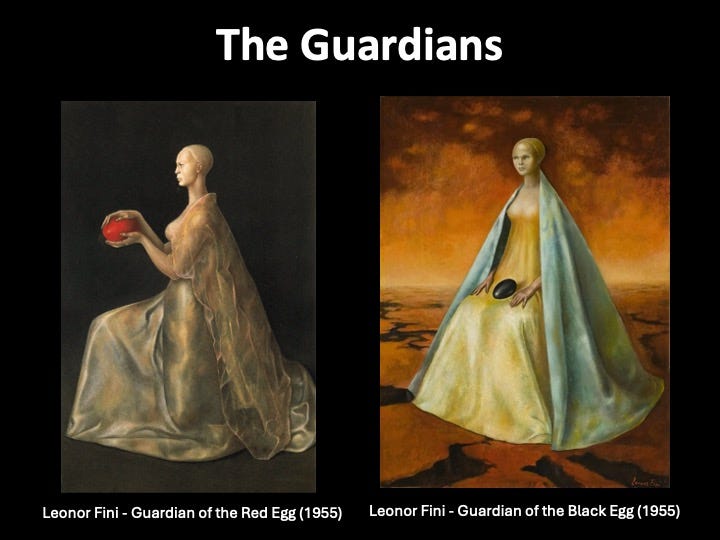
[NOTE: The great of the great among painters, like dancers, are not just painters, they are philosophers, they are alchemists, they reveal what cannot be revealed, they articulate that for which there are no words. Kahlo, Carrington, Varo and Fini offer irrefutable evidence of this. Here at close of our exploration of the True, the Good and the Beautiful, I offer you two powerful esoteric tomes compiled into paint strokes on canvass, Fini’s “Guardian of the Red Egg” and “Guardian of the Black Egg.”
Poet Karen Neuberg constructs a worthy poetical frame for these painting-portals:
“What else to do but what is expected - safeguard the red egg / I hold aloft between my palms. I feel its life pulsing inside the shell / Time to start the crack, break the seal …”
“The sun spills and warms. The black egg is restless to free its fire creature - dragon or phoenix. And then we’ll see what kind of future there will be.”
- Karen Neuberg, After Leonor Fini’s Egg Guardian Paintings, Ekphrastic Review, 9/7/24
The 36 (Ecerpt from “Words of Power”)
A lot of “New Age” malarkey and mumbo-jumbo has sprung up around this subject of “spiritual hierarchy,” and a lot what Joe would call “astral real estate” has been sold based on that malarkey and mumbo-jumbo. So let me demystify it with a jewel of insight I came across in the work of the great 20th Century Sufi saint, Inayat Khan (remember, he was one of Sam’s teachers): “The whole secret of the hierarchy is in the expansion of the heart.” That’s it. Not in robes, not in titles, not in lineages, not in “transmission.” Indeed, in spite of robes, titles, lineages and “transmissions.” “The whole secret of the hierarchy is in the expansion of the heart.” The greater your capacity for love, the greater the container that your open heart offers the world around you, the deeper you move into the true hierarchy of the planet, and the deeper you move, the higher you ascend. That’s it, the whole secret – the boundlessness of your love, the fathomless depths of your compassion. Nothing more. And more often than not, it goes unseen, unspoken, unrecognized, unheralded. Simply the expansion of the heart; the more it expands the deeper you go, the higher you ascend. That’s the secret. Yes, envision, if you will, the expansion of the heart as the secret of the hierarchy, reaching outward from the “black hole” at the center of the Milky Way, in concentric circles, and then see “the 36” as just one of the circles.
Guardians (Excerpted from “I, the Dragon”
The path of love leads to a gateway high in the mountains. That portal is never left unattended. Wayfarers arrive there, famished and near death. The gatekeepers provide each weary pilgrim with a loaf of bread and a full wineskin. They also teach each one a song, then point the way to the inner valley. But the “Land of the Gods” isn’t what you dreamt it would be. It is simply a series of interlocking gateways high in the mountains. One by one, the wayfarers leave the road and tend to the gates. There are infinite trails leading into the mountains, there are infinite beings traversing them, there are infinite portals along the trails. But there are only a finite number of gatekeepers at any particular time. There are many opportunities. The rewards, however, are hard to understand—unless, of course, you have ever arrived famished and near death at one of the portals and were met there by a gatekeeper who taught you a song and showed you the way.
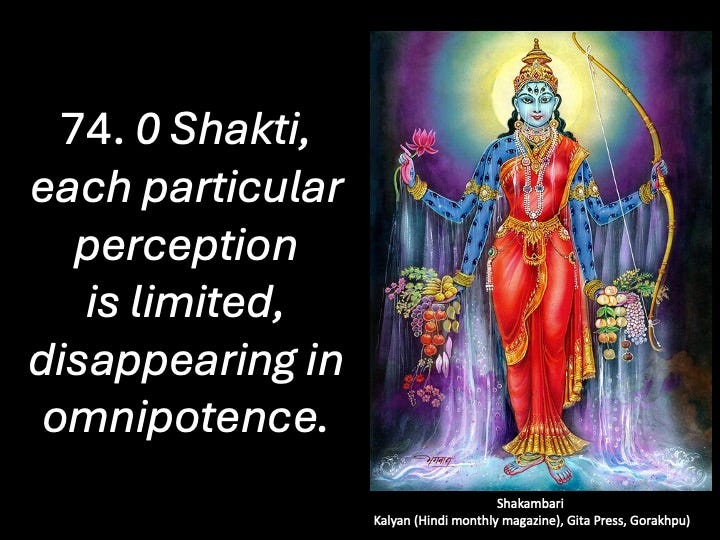
Richard Power - Vectors of Reality, Part 3: The True, The Good, The Beautiful